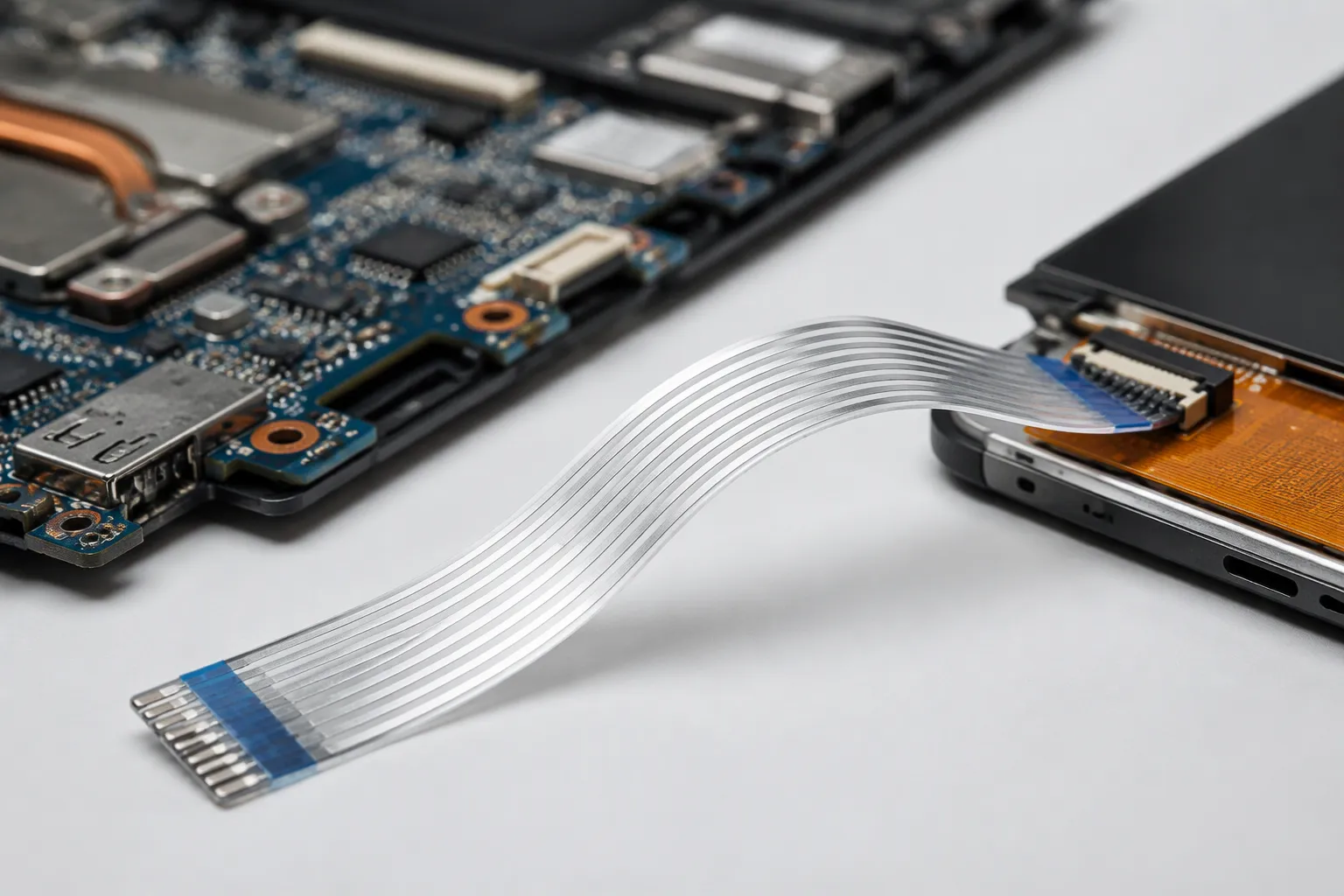
An FFC, short for Flat Flexible Cable, is a thin ribbon of flat conductors placed side by side and sealed between flexible insulating films. Each FFC cable gives a direct point-to-point connection in a low-profile package. These cables are important in modern electronics because they bend, fold, and fit into tight spaces that round wires cannot reach. Conductor counts range from 4 to 100 pins, and cable thickness stays between 0.10 and 0.35 mm, so designers can route signals through narrow gaps. Common setups include the 6-60pin AWM 20624 FFC Cable and related IDC Flat Ribbon Cable assemblies. Their flexibility supports many uses inside compact devices.
Key Takeaways
An FFC cable is a thin, flat cable. It has parallel copper strips sealed between plastic films.
FFC cables bend and fold easily so they can fit into tight spaces inside devices.
FFC cables are different from FPC cables because they use separate wires instead of etched traces.
FFC cables are used in phones, laptops, cars, and medical devices.
FFC cables need special connectors, such as ZIF or LIF, to work safely.
What Is an FFC Cable?
FFC stands for "Flat Flexible Cable." It is a thin cable that uses flat conductors set side by side. These conductors give a direct 1:1 connection between electronic parts. An FFC cable is flat and bends easily, and it carries flat solid conductors instead of round wires. The term usually means the very thin flat cable used in high-density electronics like laptops and cell phones.
Flexible Flat Cable Basics
A flexible flat cable is usually made of flat, parallel conductors sealed between insulating films, often polyester. The conductor spacing and contact pitch follow the cable design. Standard options are usually defined by conductor count, pitch, length, exposed-contact orientation, and reinforced ends. Each end often has a stiffener to make insertion easier or to provide strain relief.
Designers pick an FFC cable when they need a compact, low-profile connection between parts or circuit boards. Available setups include 6-pin, 10-pin, 14-pin, and 60-pin versions, plus 6-60pin FFC cable and AWM 20624 FFC cable options. These are examples of available setups, not universal specs for every cable. The flat flexible cable is thinner than ribbon cable, which is also flat and flexible but uses round conductors.
FFC vs. FPC
An FPC uses a flexible printed-circuit structure with etched conductive traces on a flexible base. An FFC uses separate, parallel flat conductors sealed between insulating films. That structural difference drives most of the practical choices in an FFC vs. FPC comparison.
Factor
FFC
FPC
Structure
Parallel conductors in plastic film
Etched copper traces on polyimide or polyester
Cost
Generally more affordable
Higher due to manufacturing complexity
Routing
Simple linear layouts
Custom pad layouts and irregular shapes
Best fit
Standard, cost-sensitive links
Complex, space-constrained designs
An FFC suits standard, space-saving cable connections, such as 0.5 mm or 1.0 mm pitch links where cost and lead time matter most. An FPC flat flexible cable suits designs that need integrated traces, shaped geometry, shielding, or a flex zone tested for repeated bending. Both are good solutions, and the real difference is whether the product needs a simple interconnect or a custom mechanical-electrical package.
FFC Cable Structure
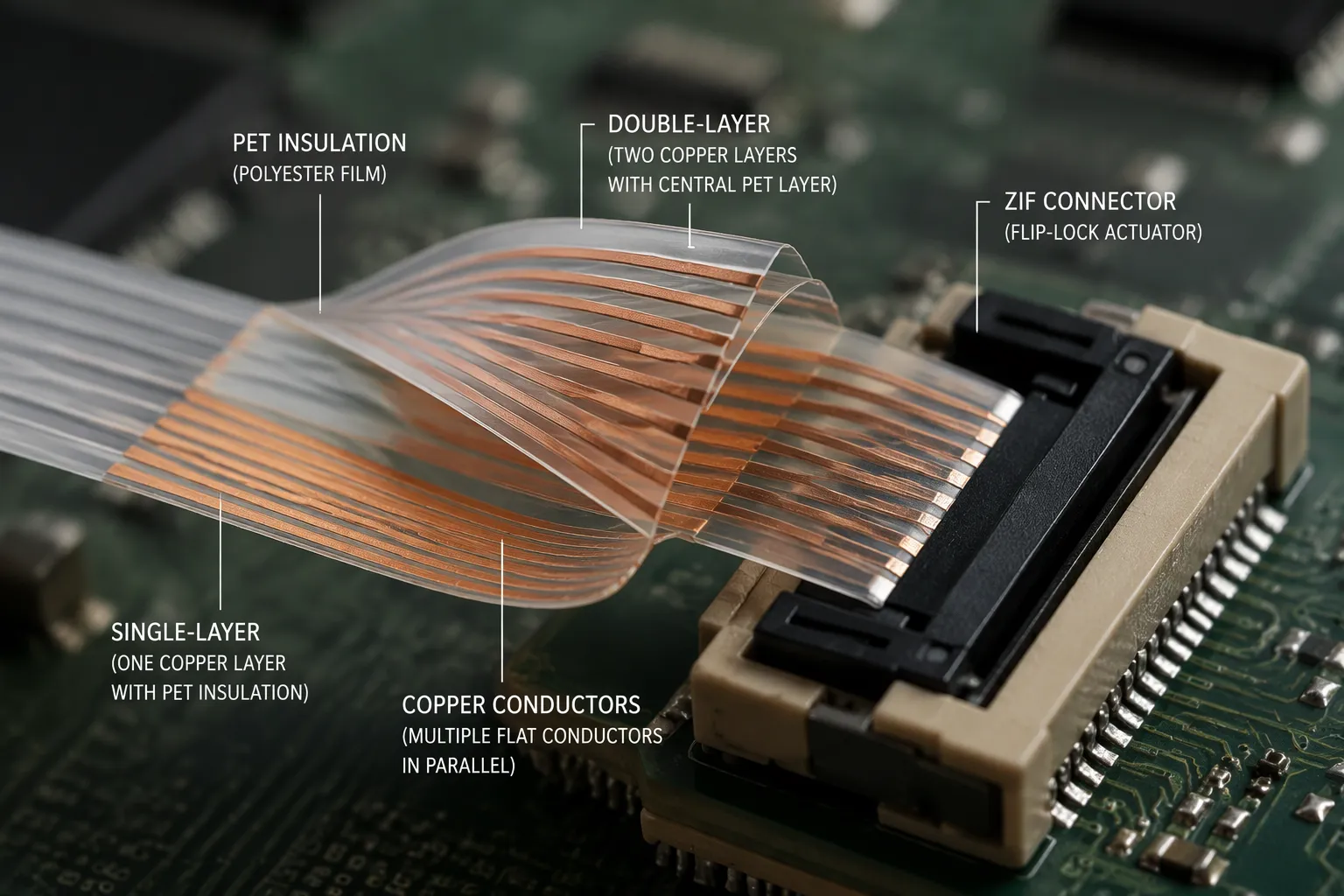
An FFC cable is a layered ribbon of conductors held together by thin plastic film. The build starts with several flat metal conductors laid out straight and parallel. A flat, flexible plastic film base sticks to both sides and holds the conductors in place. This single layered structure keeps the conductors the same distance apart along the whole length of the cable.
Conductors and Insulation
The flat solid conductors form the electrical core of the cable. Copper is the usual conductor material, and polyester (PET) is the common insulation. The number of conductors (pins) ranges from 4 to 100, and the design sets the pitch between them. The parallel structure supports clean signal integrity because every trace keeps the same position from end to end. Steady trace spacing also helps when the cable bends inside a tight enclosure.
Two layer builds are common. A single-layer FFC puts one copper layer on one side of a PET film. A double-layer FFC puts two copper layers, top and bottom, around a central PET layer. The double-layer version forms a symmetrical sandwich of conductor, insulator, conductor, insulator, conductor. This design can carry an internal ground plane or paired differential pairs. It differs from a two-sided FPC, which may use plated-through holes and complex layer interconnects.
FFC Type
Layer Structure
Single-Layer FFC
One copper layer laminated to one side of PET film.
Double-Layer FFC
Two copper layers, top and bottom, separated by a central PET layer.
Connectors and Termination
Board connectors join the cable to a circuit board. The mating part sits on the terminal, and the cable slides into the housing. Several lock styles exist. A ZIF connector uses an actuator to cut insertion force to almost zero. A LIF connector needs a small insertion force and suits links that stay connected. Slide lock, front flip, flip lock, back flip, and one-action lock styles each move the actuator in a different way. One-action lock types secure the cable in a single push, while a typical ZIF part needs three steps: open the lock, insert the cable, close the lock.
Pitch options run from 0.5 mm to 2.54 mm, and housings come in right-angle or vertical mounting with top, bottom, or dual contact. Termination choices include stiffeners that back the exposed contacts for easier insertion, plus solder, crimp, and insulation displacement methods. The right materials and lock style protect the exposed contacts and keep the connection stable through vibration and repeated handling.
FFC Cable Applications and Flat Cable Assemblies
Consumer Electronics and Automotive
Consumer electronics depend on the FFC cable when a board needs to reach a display, camera, or printer head. Smartphones, tablets, notebooks, gaming devices, drones, wearables, LCD monitors, and 3-D printers all use these links. A flexible flat cable also carries high-speed connections for USB and HDMI. Versions with 90-Ohm and 100-Ohm impedance support video displays and cameras. The slim shape lets designers fold the cable around a hinge or tuck it behind a screen.
Automotive designs use FFC assemblies in dashboards, infotainment systems, and sensor links. Cameras in driver-assistance systems send data to a central processor. Battery management units connect sensors and control boards the same way. These parts face vibration, moisture, and big temperature swings, so the connectors and materials must hold tight over years of service.
Medical, Industrial, and Flexible Flat Cable Assemblies
Medical devices benefit from the thin overall profile and light weight of an extremely thin flat cable. Imaging machines and bedside monitors need precise connections inside crowded housings. A flat cable assembly bends into spaces a round bundle cannot enter. Industrial equipment follows the same idea, where flat cable assemblies fit into control panels and moving arms.
Flat cable assemblies suit compact and moving-part designs for three reasons. They take up about half the space of similar round cable, and their flat shape allows stacking with little wasted room. Their bend radius is a small fraction of round cable, and some designs reach a 1-million flex-cycle life. Fixed conductor spacing also keeps impedance, capacitance, and crosstalk steady. This protects signal integrity and allows efficient routing of signals across a dense board.
Standard systems use 0.50 mm and 1.00 mm pitch with zero insertion force connectors. Custom flexible flat cable assemblies, including 6-60pin AWM 20624 options, are available from Suyi through its custom wire harness program. These applications show why the FFC remains a default choice for tight, thin designs.
An FFC is a flat cable that sends signals through parallel copper strips sealed between thin insulating films. The structure stays simple: flat conductors, PET insulation, and optional ZIF connectors at each end. The cable stays under about 0.35 mm thick, so it slides into tight spaces easily. Its main uses cover consumer electronics, automotive dashboards and sensors, medical devices, and industrial equipment. Each of these areas values the same traits: a low profile, easy bending, and steady conductor spacing. The FFC will keep serving compact electronics as devices get thinner and denser.
FAQ
What does FFC stand for?
FFC stands for Flat Flexible Cable. The name tells you how it is built: flat copper conductors sealed between thin insulating films. Designers use this cable for low-profile, point-to-point links inside compact devices.
How does an FFC differ from an FPC?
An FFC uses separate parallel conductors laminated between plastic films. An FPC uses etched copper traces on a flexible substrate. The FFC works well for standard, cost-sensitive links. The FPC works well for custom layouts that need shaped geometry or repeated bending.
What pin counts and pitches are common?
Common setups range from 4 to 100 pins, and 6-pin, 10-pin, 14-pin, and 60-pin versions are easy to find. Pitch options run from 0.5 mm to 2.54 mm. The design sets the conductor spacing and contact pitch.
Where do designers use an ffc cable?
Designers use the cable in smartphones, tablets, notebooks, printers, automotive dashboards, medical monitors, and industrial control panels. Every application values the same traits: a thin profile, easy bending, and steady conductor spacing.
Do FFC cables need special connectors?
Yes. The cable usually mates with a ZIF or LIF connector on the board. A ZIF connector uses an actuator to cut insertion force to almost zero. Stiffeners on the exposed contacts make insertion easier and add strain relief.