A custom wire harness carries power and signals through your product. Its quality directly affects reliability and safety. That makes choosing a custom wire harness manufacturer a high-stakes decision, not a routine purchase.
This guide lays out the traits that separate reliable suppliers from risky ones. It then walks you through a clear, step-by-step selection process. You can apply each step to your next project right away.
Key Takeaways
Figure out your wire harness specs and how many you need before you reach out to suppliers.
Make sure the manufacturer has the correct certifications for your industry.
Check if they can customize by providing prototype samples and engineering support.
Compare quotes by the total value, not just the price for one unit.
Place a small test order first. This lets you check quality and communication before you commit to a large amount.
Traits of a Reliable Wire Harness Manufacturer
A dependable wire harness manufacturer shows three strengths at once: proven quality systems, deep customization capability, and a supply chain that delivers on schedule. You can check each one before you sign a contract.
Quality Standards and Technical Expertise
Match certifications to your application, not to a generic checklist. Automotive OEM work calls for IATF 16949. Medical devices require ISO 13485. Aerospace programs need AS9100. Products sold in North America typically need UL recognition. ISO 9001 applies to all professional manufacturing. For workmanship, IPC/WHMA-A-620 is the recognized acceptability standard for cable and wire harness assemblies, and trained inspectors apply it to every build.
Certification
Focus Area
Required For
ISO 9001
Quality Management System
All professional manufacturing
IATF 16949
Automotive Quality
OEM automotive supply chain
UL
Electrical Safety
Products sold in North America
IPC/WHMA-A-620
Workmanship Standard
Quality-conscious customers
ISO 13485
Medical Device QMS
Medical device manufacturers
AS9100
Aerospace and defense quality management
Aerospace
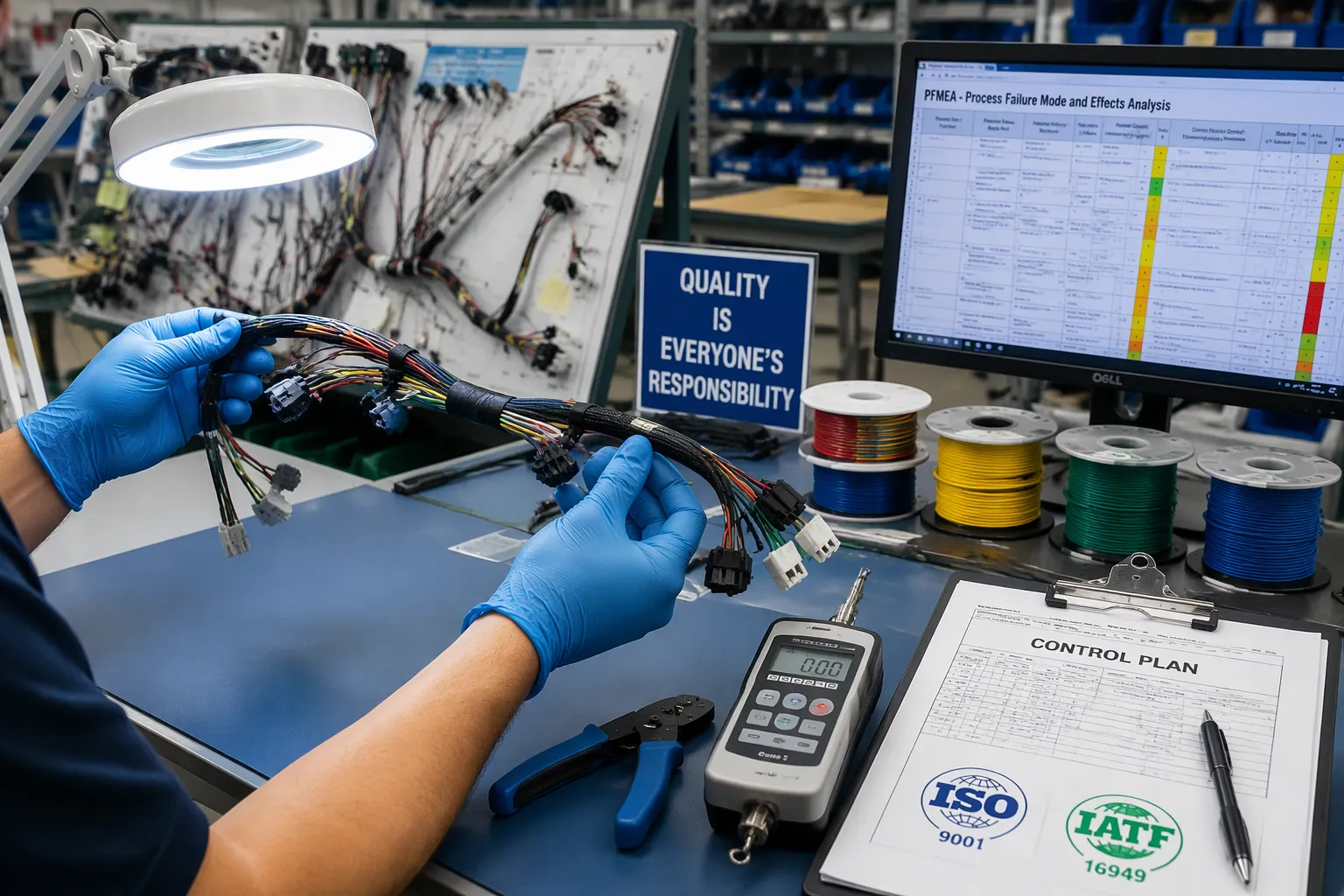
Confirm the actual build location and the audit process behind the certificate. Ask for the PFMEA, the control plan, crimp-height logs, pull-test data, and traceability labels. Walk the line from receiving to crimping, assembly boards, testing, and outgoing inspection. Compare the paperwork to what operators actually do. If the control plan promises hourly crimp verification and no check sheet exists at the station, the system has a gap.
Customization and Supply Chain Strength
Top wire harness manufacturers build strictly to your own specification. That means any wire type, gauge, insulation style, and color, plus any number of wires and breakouts. This depth matters. Generic pre-terminated cables leave service loops, and that slack adds weight, acts as an antenna for electromagnetic interference, and stresses the crimp joint in high-vibration environments. A custom 3D-routed harness removes the guesswork and speeds installation.
Suyi illustrates this customization capability well. The company offers in-house design, development and manufacturing across silicone harnesses, power cords, antennas, FFC cables, new energy storage cables, DB connectors, IDC ribbon cables, JST/Molex harnesses, XT30/XT60/XT90 connectors, CAT-5E/CAT-6E RJ45 harnesses, and high-current Anderson harnesses. That range covers simple assemblies and complex custom wire harnesses and cable assemblies alike.
Beyond the product list, weigh supply chain reliability, advanced machinery, R&D support, customer service, on-time delivery, and cost efficiency. Ask about harness design services and engineering support for industrial processing wire harness projects. A manufacturer with strong technical expertise will show you how one critical characteristic, such as crimp height, flows from your customer specification through PFMEA, control plan, operator check sheet, gauge record, and final approval. That discipline is what separates reliable wire harnesses from risky ones.
Step 1: Define Your Custom Wire Harness Requirements
Document Specifications and Volumes
Write down your specifications before you talk to any supplier. A clear document makes every later talk shorter and stops costly rework. Write down these details for each build:
Connector brand and part number for every position, like Molex, JST, TE, or Amphenol. Give a sample or mating connector if you don't know the series name.
Wire type, defined by its construction standard. UL1007 is a common example, and UL1015 and UL1571 also exist.
Wire gauge in AWG. A 28AWG wire works for small signals, and bigger current loads need a lower AWG number.
Wire color and pin function for each circuit, like Power+, GND, or Signal. Different colors in adjacent identical connectors help assemblers avoid mixed circuits.
Length of every loop and branch.
Locking and polarization needs, jacketing, shielding, and any regulatory requirements for your markets.
Add the mating connector part number, the crimp contact part number, and any special crimp tool part number. Your expected volumes and target certifications belong in the same file. Volume data lets the manufacturer plan tooling and capacity, and certification needs shape which quality system applies.
Set Budget and Timeline Expectations
Set a realistic budget range and a timeline you can defend to your team. Unit price alone tells you little. Ask what the quote includes, like engineering review, test reports, and documentation. Many manufacturers include a basic design review at no consulting fee, and that review often catches manufacturability issues before tooling starts.
Note your future production needs now. A partner who understands your scaling path can suggest cost optimizations and flag production challenges early. Request a documentation package with assembly drawings, test results, and a bill of materials. That package supports design reviews and gets your custom wire harnesses ready for larger runs. Realistic lead times matter too, so confirm prototype schedules against your development milestones. Treat the customer specification as a living document, and update it as volumes grow. This habit keeps your industrial processing wire harness projects on schedule. The same discipline applies to any custom assembly, and it makes your industrial processing wire harness sourcing far more predictable.
Step 2: Research and Shortlist Wire Harness Manufacturers
Find and Screen Industrial Processing Wire Harness Manufacturers
Begin with four sources: industry directories, trade shows, referrals from peers, and online searches. Check each candidate against your project's industry. A supplier with deep experience in industrial and process-automation equipment will understand your environment better than a consumer-electronics specialist.
Before you shortlist any industrial processing wire harness manufacturer, confirm five points in writing. Ask for the current certificate for the exact site that would build your harness, not a company-wide claim. Confirm the plant address, because headquarters and production sites often differ. Check whether the supplier builds strictly to your specification or also offers broader contract manufacturing. Compare facility scale to your order size, since a large operation and a smaller specialist plant serve different volumes. Get tenure in writing, and do not rely on a single marketing claim.
Screening Point
What to Confirm
Quality system
Certifications published, and at which sites
Build location
Plant address in writing
Scale fit
Employee and facility count versus your volume
Product scope
Published industrial or control-system harness work
Customization
Builds to customer specification
Ask the Right Initial Questions
A short call filters weak candidates fast. Ask what industries they serve, and request similar past projects with photos. Ask for their typical lead time and whether they support custom designs. A fast quotation signals a reliable supplier. A quick drawing turnaround proves they have their own engineers.
Use the answers to rank your shortlist of industrial processing wire harness manufacturers and suppliers. Then confirm technical expertise with one more question: which tests do they run on every unit? Look for continuity checks, isolation testing, high-voltage testing where your application needs it, pull testing, and visual inspection against a workmanship standard. For critical applications, ask about temperature cycling, humidity exposure, and vibration testing. A custom wire harness company that answers these questions clearly deserves a place on your shortlist of the best wire harness manufacturers.
Step 3: Evaluate Certifications and Capabilities
Verify Quality Systems and Compliance
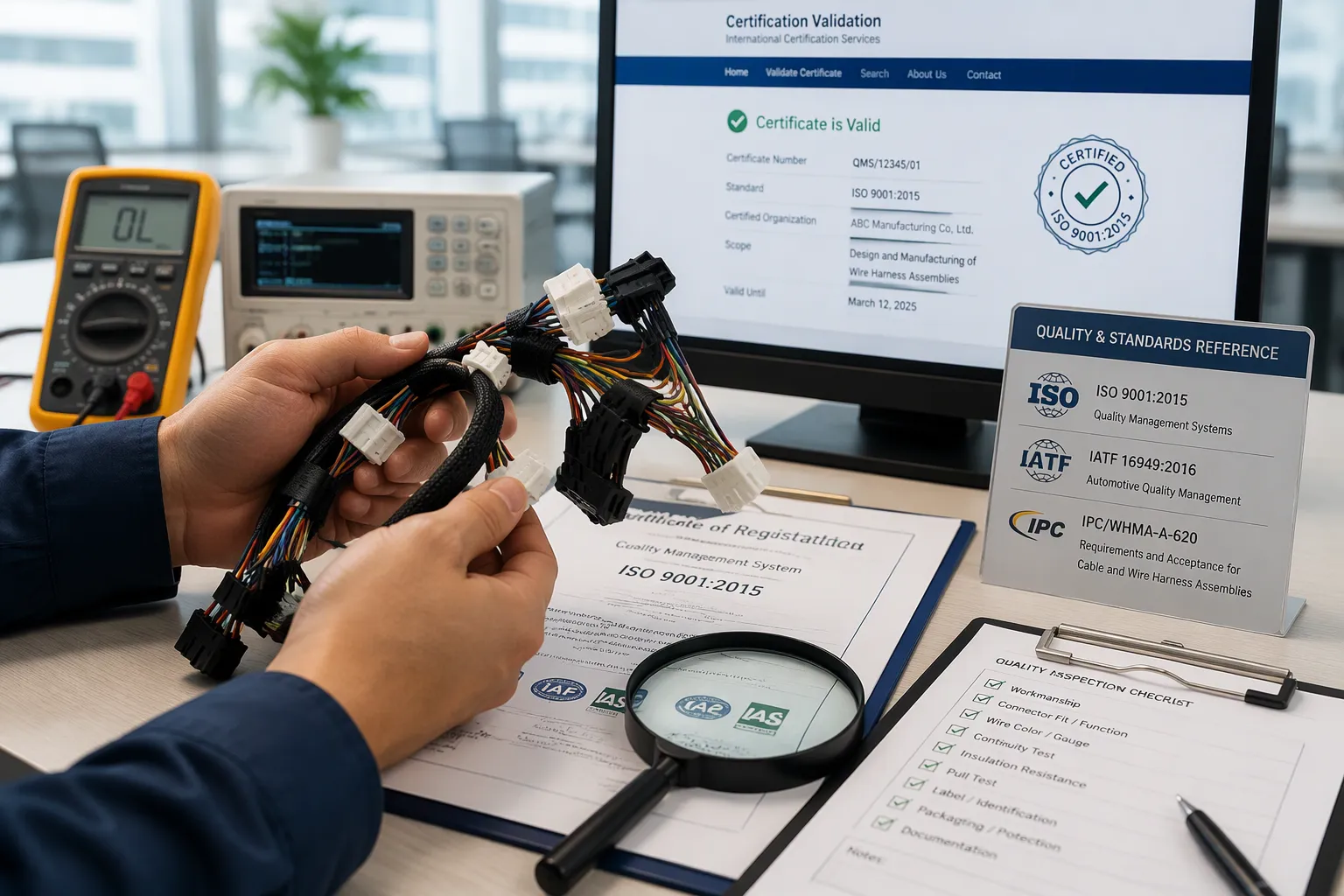
A certificate on a website proves very little. You need the current certificate for the exact site that would build your harness. Follow four steps to confirm it.
Ask for the real certificate, not just a claim. Check the issue date and the expiration date.
Check the certificate number with the issuing registrar. Most registrars offer an online or email validation service.
Check the scope. A valid certificate may not cover wire harness manufacturing.
Check the location. A company with many sites may hold certification at headquarters only.
Match the standard to your market and application. IPC/WHMA-A-620 is the main rulebook for cable and wire harness assemblies. It defines three quality levels: Class 1 for general electronics, Class 2 for extended-performance industrial equipment, and Class 3 for high-reliability applications where failure risks are significant.
Standard
Scope
ISO 9001
Quality management
IATF 16949
Automotive
AS9100
Aerospace
IPC/WHMA-A-620
Harness workmanship
For automotive work, confirm the IATF 16949 certificate came from an IATF-recognized certification body. The holder name and site address must match your supplier. The scope must cover wire harness manufacturing, and the certificate must not be expired. Then confirm the number with the issuing body. For ISO certificates, check the registrar or the IAF CertSearch database. For UL listings, search UL Product iQ.
As rules get stricter around the world—from India's BIS mandates to European REACH requirements—harnesses must show full compliance across materials, testing methods, and traceability systems.
Assess Customization and R&D Support
Strong customization shows up in samples, not brochures. Ask for prototype samples built from your drawings, samples, wiring diagrams, connector specifications, and pin definitions. Test them for continuity, wiring sequence, insulation, withstand voltage, contact resistance, pull force, and dimensional accuracy. Go over the results with your installation team before you commit to tooling.
Ask which design tools the engineering team uses. Look for CAD and CAE platforms, plus PLM, MES, and ERP systems that support process control and traceability. Confirm the manufacturer runs prototype review to catch design, structure, material, and assembly risks before mass production. In-house design, development and manufacturing matters here, because it keeps engineering, tooling, and quality teams in one loop during mold trial and sample validation.
Finally, confirm the supplier handles both simple wire harnesses and complex custom wire harnesses and cable assemblies. A capable industrial processing wire harness manufacturer will also offer harness design services and engineering review of your application. Ask one industrial processing wire harness manufacturer to walk you through a recent prototype project from drawing to validation. That answer reveals real technical expertise and quality standards compliance faster than any certificate alone. A partner with genuine capability will welcome the question.
Step 4: Compare Quotes and Make the Final Decision
Check Supply Chain and Delivery Reliability
Delivery reliability starts with good inventory control. Good inventory management cuts delays and material shortages. A just-in-time approach brings parts in exactly when needed. This cuts extra stock and storage costs. Strong supplier relationships also help with better pricing and a steady flow of materials.
Ask each candidate how they manage stock for your program. Look for these abilities:
Custom inventory programs like Kanban, vendor-managed inventory, and consignment, matched to how accurate your forecasts are.
Worldwide inventory access, with stock visibility to support deliveries across many sites and countries.
An EDI platform that covers purchase orders, order acknowledgments, advance ship notices, invoices, and inventory reports. EDI cuts lead-time swings and removes manual data-entry errors.
Barcoding with lot-level and serial-level traceability, so scans confirm each kit is built to spec.
Real-time carrier tracking with exceptions flagged for quick fixing, plus shipping links with UPS and FedEx.
Also weigh facility size against your order. A plant sized to your volume responds faster when demand changes.
Compare Costs and Confirm the Partnership
Compare quotes on total value, not unit price alone. A low quote that leaves out test reports or paperwork costs more later. Put payment terms, tooling ownership, and change-order rules in writing. Ask for references from customers with similar programs. Ask those contacts about on-time delivery records and how the manufacturer handles problems.
Then confirm the partnership with a trial order. A small run tests quality, communication, and lead time before you commit to volume. Use the results to rank your shortlist of industrial processing wire harness manufacturers and suppliers. The best wire harness manufacturers earn that rank through steady execution, not the lowest bid. Treat the trial as a checkpoint for any industrial processing wire harness program, and let a proven manufacturer grow with your production needs.
Picking a custom wire harness manufacturer works best when you follow a clear plan. Look at quality systems, technical skills, supply chain reliability, and cost as a group. Balance matters more than any one strength. No single factor decides the result.
Define your needs before you contact suppliers. Judge every candidate against clear criteria. This habit saves time and lowers risk at each stage.
Use these four steps on your next project. Ask focused questions at every stage, from specifications to the trial order. The right partner then supports your product long after the first shipment. That partnership protects reliability, controls cost, and helps your product succeed in the market.
FAQ
What certifications should a wire harness manufacturer hold?
Pick the certificate that fits your market. ISO 9001 covers general manufacturing. Automotive work needs IATF 16949, aerospace needs AS9100, and medical devices need ISO 13485. Products sold in North America usually need UL recognition. For workmanship, look for IPC/WHMA-A-620. Always make sure the certificate covers the exact site that will build your harness.
Can a manufacturer build a harness to my exact drawing?
Yes, a good supplier builds strictly to your specification. That covers any wire type, gauge, insulation, and color, plus any number of wires and breakouts. Send your drawings, samples, and pin definitions. Ask for prototype samples first, then test continuity, pull force, and dimensional accuracy before you approve tooling.
How long does a custom wire harness order take?
Lead time depends on complexity, material availability, and order volume. Ask each candidate for their typical lead time in writing, and check prototype schedules against your development milestones. A fast quotation and quick drawing turnaround usually mean a responsive supplier with in-house engineers.
Should I place a trial order before committing to volume?
Yes. A small trial run tests quality, communication, and delivery before you commit to full production. Use it as a checkpoint. Review the test reports and documentation from that run, then compare the results against your specifications. A proven manufacturer will welcome this step.
What should I include in my request for a quote?
Include connector brand and part numbers, wire type and gauge, color and pin function, loop and branch lengths, and your expected volumes. Add locking, shielding, and regulatory needs. Volume data lets the manufacturer plan tooling and capacity, and it helps them spot cost savings early.